DAK Mortgage – Florida and California Mortgage Broker

DAK Mortgage – Florida and California Mortgage Broker
Looking to finance a luxury home in Florida or California without the hassle of providing tax returns and paystubs? The no-ratio mortgage loan offers streamlined approvals, up to 80% loan-to-value, and no calculation of your debt-to-income ratio.
Under the no-ratio loan program, there are no income or employment requirements. Instead, the lender determines your ability to repay the loan based on other factors. You’ll need a good credit score of at least 620. You’ll also need to provide statements from your checking or savings accounts to prove to the lender you can meet your monthly mortgage payments regularly and on time (at least 6 to 9 months of post-closing reserves).
Continue reading to learn more about this powerful solution for owner-occupied purchases and refinances in Florida and California’s real estate markets.
A no ratio loan is a mortgage that does not require any calculation of the borrower’s debt-to-income ratio (DTI) (hence why it’s called “no-ratio”). Quite simply, there is no verification of employment or income required.
These loans are designed for borrowers with non-traditional income streams, such as high-net-worth individuals, self-employed people, business owners, seasonal workers, retirees and even individuals who are currently unemployed.
When applying for a loan with a conventional mortgage lender, you must provide your income and occupation details. By contrast, for a no-ratio mortgage, you skip the income and employment sections on the loan application; you just leave those sections blank.
This type of mortgage is only offered by alternative lenders known as non-qualified mortgage (non-QM) lenders, which specialize in offering creative, outside-the-box loan solutions.
The main highlights of the no-ratio mortgage include:
It’s also important to note that while these loans offer a unique avenue for mortgage approval, they might come with different terms and conditions compared to traditional loans, such as potentially higher interest rates or stricter credit score requirements.
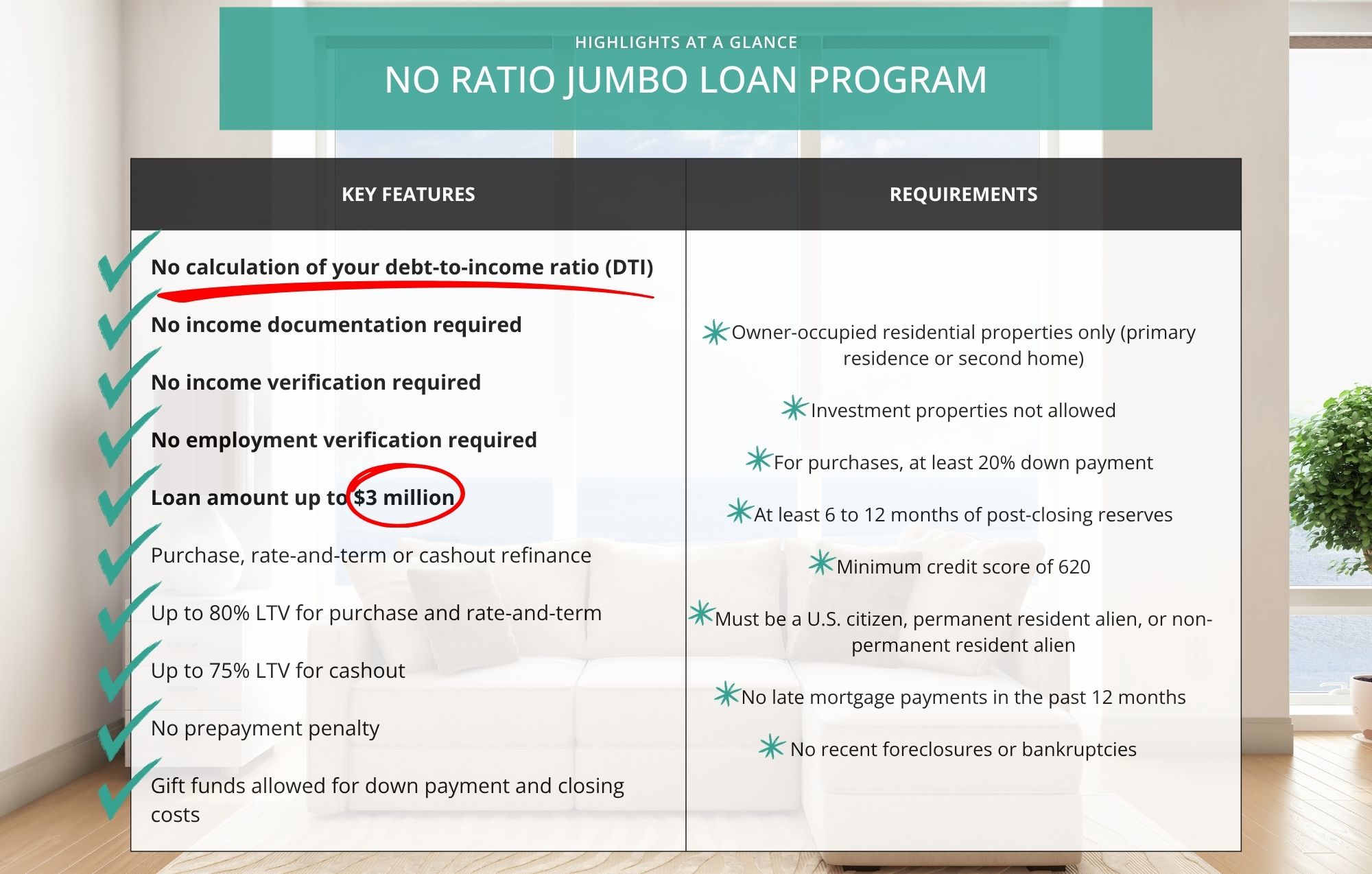
Yes, jumbo no ratio loans are available up to $3 million for purchases and refinances. Jumbo loans (also called non-conforming loans) exceed certain limits set each year by the Federal Housing Finance Agency (FHFA).
In 2026, the conforming loan limit is $832,750 for single-family residences in most counties. Therefore, if you’re looking to qualify for a jumbo loan amount between $832,751 and $3 million, consider getting a jumbo no ratio loan.
The jumbo no-ratio program is particularly beneficial for high-net-worth individuals who may have significant assets but prefer not to disclose their income or for those whose income might not qualify under traditional loan standards.
This option also opens up opportunities for borrowers seeking to qualify for jumbo loans to purchase or refinance luxury homes or expensive properties in high-cost neighborhoods.
However, it’s important to understand that, compared to conventional conforming loans, the lender will likely require a higher credit score and plentiful reserves to mitigate the risk associated with the larger loan amount.
While the no-ratio program caps the loan amount at $3 million, there are super jumbo loan programs offering loan amounts up to $30 million. Discover more about super jumbo mortgages tailored for HNW borrowers.
The no ratio program stands apart from traditional mortgage options. The fundamental difference lies in the assessment of the borrower’s income and debt.
In traditional mortgages, a key factor in determining eligibility is the borrower’s DTI ratio. This ratio measures the percentage of a borrower’s monthly gross income that goes towards paying debts. Lenders use DTI to gauge the borrower’s ability to manage monthly payments and repay the loan.
Typically, traditional lenders require a DTI no greater than 43-45%. This is difficult for many individuals to satisfy, especially if their tax returns show relatively low income.
On the other hand, under the no ratio program, the borrower’s DTI is not calculated or considered during the loan approval process.
Therefore, by applying for a no-ratio mortgage, the borrower doesn’t have to worry at all about their DTI.
If you apply for a no-ratio mortgage, the focus shifts from income and occupation confirmation to three main factors:
Therefore, even though you don’t have to satisfy any debt-to-income ratio requirements, there are still hoops to jump through to qualify for this niche loan.
We analyze each of these main no ratio requirements in turn.
The down payment or loan-to-value (LTV) is a key element in the application process.
Unlike traditional loans, where the down payment can sometimes be lower, no ratio mortgages often require a larger down payment. This is because the lender is taking on more risk by not considering your DTI ratio. A significant down payment demonstrates your commitment and financial capability, providing reassurance to the lender.
If you’re looking to purchase a property under the no-ratio program, here are some typical down payment requirements to expect:
In the context of refinances, the equivalent “skin in the game” factor is the LTV. Here are some typical refinance LTVs to expect under the no-ratio program:
Please note that the maximum LTVs listed above can be subject to special caps, such as for condominium loans, and loans for properties in declining markets.
Potential borrowers need to be prepared for these requirements and plan their finances accordingly.
Since your income and work are not being analyzed at all, a strong credit history is paramount. Lenders will scrutinize your credit report to assess your reliability in managing and repaying debts.
Most no-ratio lenders require a minimum credit score of 660 or 680, regardless of whether you’re looking for a purchase loan or a refinance.
However, some no-ratio lenders have more relaxed guidelines allowing credit scores as low as 620. But, please note that if your score is between 620 and 660, you’ll be limited to a maximum LTV of 60% (for purchases and rate-and-term refinances) or 55% (for cashout refinances) and a maximum loan amount of $2 million.
Your credit score is only part of the equation. The lender will typically also have these credit requirements:
In short, a relatively high credit score and blemish-free credit history are more critical in no-ratio applications, as they are indicators of the borrower’s history of managing credit responsibly.
Under the no-ratio program, the lender will closely examine the borrower’s assets to ensure sufficient financial stability beyond the closing table.
At a minimum, you’ll be required to have at least 6 to 12 months of reserves.
Therefore, as a tradeoff for not having to document your income or job, you’ll need to show the lender you have enough assets to make 6 to 12 months of payments. Each monthly payment consists of Principal, Interest, Taxes, Insurance, and any Association fees (PITIA).
For cash-out refinances, it is beneficial to know that the cashout proceeds from the loan may be used toward satisfying the reserves requirement. For higher LTVs, you may be required to show 2 months of reserves from your own funds, but the remaining months may be satisfied by the cashout proceeds.

A home equity sharing agreement (also called a home equity investment) is an alternative financial product that allows you to receive cash in exchange for a percentage of your home’s future appreciation, without taking on a new mortgage.
Here’s a brief comparison to highlight the differences:
| No-Ratio Cashout Refinance | Home Equity Sharing | |
|---|---|---|
| Monthly Payment | Yes (principal and interest plus escrows for insurance and taxes) | No (but there may be fees) |
| Ownership Dilution | None; you keep your home equity | Yes; you sell a percentage of future appreciation |
| Maximum Funding | Up to 80% LTV | Varies by provider; typically lower than mortgage loan amounts |
| Tax Impact | Interest may be tax-deductible | May have capital gains implications |
We know what no income verification mortgage lenders look for.
Understanding the advantages and disadvantages of no ratio mortgage loans is crucial for anyone considering this type of financing.
Here are some of the advantages that no ratio mortgage loans offer:
However, there are disadvantages to consider:
Deciding whether a no ratio mortgage loan is the right choice depends on your unique financial situation. These loans are designed for individuals who don’t qualify for traditional mortgage loans.
Let’s explore when it might be appropriate to consider a no ratio mortgage loan.
Traditional jumbo loans have strict requirements regarding income and employment. If you’re in a bidding war for high-value real estate (especially in top destination cities in California and Florida), you may not have time to qualify for a traditional jumbo loan. Instead, apply for a no ratio jumbo mortgage, where you can qualify with no income corroboration up to a loan amount of $3 million.
Want to have your cake and eat it, too? If you have a credit score of at least 740, you can qualify for both a high loan amount and a high LTV: 80% LTV up to $3M for purchases and rate-and-term refinances; and 70% LTV up to $3M for cashout refinances.
Self-employed professionals, consultants, or business owners may have strong liquidity but inconsistent income. With a no-ratio jumbo loan, they bypass all income and work requirements to purchase or refinance a Florida or California residence.
These borrowers often reach out after being told “no” by their private bank, even with high six-figure account balances. They’re often looking to close quickly or secure pre-approvals without disrupting ongoing business operations.
If you’re looking for a self employed mortgage, we can help you explore the no-ratio loan and other programs tailored for self-employed borrowers.
Individuals with volatile or irregular income may include:
These borrowers often face challenges in securing traditional mortgages. The no ratio solution does not require any income authentication at all. Instead of going to a bank or other traditional lender, apply instead for a no ratio mortgage loan based on factors other than income and occupation.
You may have recently become self-employed. Or you may have switched to a job in a new industry with a variable income. Or you may even be in between jobs.
Whether it’s a career change or a gap in employment, you lack the two-year history of steady income that traditional lenders require.
The no-DTI loan might be the solution today, with the opportunity to refinance into a more conventional loan in the future once a continuous track record of work is established.
A commonly asked question is, “Can I get a mortgage without a job?” The answer is yes, and the no-ratio program is one of the solutions available for the unemployed. While it seems counterintuitive, the lender uses other metrics besides income and position to confirm the borrower’s ability to repay the loan, such as credit score and post-closing reserves.
Retirees who have significant savings or brokerage accounts but limited monthly income can use the no ratio program to finance their homes. This is an especially effective solution for retirees who need a significant amount of cash. Instead of selling off their retirement assets, the borrower can do a cash-out refinance to tap into their equity.
While foreign nationals are not eligible for the no-ratio program, permanent resident aliens and non-permanent resident aliens (with US credit and an acceptable visa) may apply.
International buyers, especially from Canada, Europe, and Latin America, often turn to no-ratio jumbo loans when purchasing California or Florida second homes or vacation condos.
We’ve helped snowbirds from Toronto, business owners from Mexico City, and executives from São Paulo secure properties in the warm climates of Florida and California, despite having no US income.
While the no-ratio program is unavailable for financing rental investment properties, it can be a good solution for real estate investors looking to purchase or refinance their primary residence or second home.
Real estate investors who own several rental properties often have artificially low income on their tax returns due to the various write-offs. They can therefore benefit from the no-ratio program.
Also, because no-ratio lenders are non-QM lenders, they allow the borrower to simultaneously have up to 10 mortgages. For example, if the borrower already has 9 rental investment properties, each with its own mortgage, they can apply for a 10th mortgage through the no-ratio program.

Here’s a comparison to illustrate why a no-ratio jumbo loan might be the superior choice over a standard jumbo mortgage for your specific needs:
| No-Ratio Jumbo Loan | Traditional Jumbo Loan | |
|---|---|---|
| Income Documentation | None required | 2 years of tax returns, W-2s, paystubs, etc. for a complete DTI analysis |
| Approval Speed | Streamlined | Slower due to extensive income analysis |
| Ideal For | Self-employed; high-net-worth individuals; small business owners; seasonal & gig-based workers; online or cash-based business owners; influencers, artists | Employed borrowers with at least 2 years of steady income and employment history |
No income loans are revolutionary loan programs.
Due to the perceived higher risk by lenders, as income is not verified, no ratio rates are typically higher compared to traditional mortgages.
To help take the sting out a little, here are some factors that may lower the rate you’re offered:
Understanding these factors can help you better prepare for the financial implications and budget accordingly.
Navigating the application process under the no-ratio program can be markedly different than traditional mortgages. Understanding this process is key to a smooth and successful application.
Here’s a general outline of how to get a no ratio mortgage:
At DAK Mortgage, we’ve had the privilege of helping numerous clients secure a no ratio home loan. Here are some success stories that highlight the effectiveness and versatility of this loan program:
Our clients in Key West faced a challenge when they went over their construction budget for their dream home. They needed to refinance quickly, as their private construction loan was about to balloon. With one borrower furloughed and the other having a high DTI, traditional refinancing options were off the table. We introduced them to the no-ratio program, which perfectly suited their situation. Without the need for income confirmation or DTI calculation, we secured a $1.32 million loan for them with a 5/6 adjustable-rate mortgage (ARM) term, significantly reducing their interest rate.
Our client, a real estate investor, had an extensive portfolio of rental properties. Because she showed little income on her tax returns, the no-ratio program was ideal for her. We secured a 60% LTV cashout refinance at a loan amount of $1,104,000. After paying closing costs and paying off her current lender, she used the $350,000 in net proceeds to invest in more real estate.

Our client, a commercial developer, wanted to move from Maryland to Orlando, Florida but struggled with loan approval due to a high DTI and low reportable income. The no ratio program provided a solution with no income documentation required. We secured a 30-year fixed interest rate loan with a jumbo loan amount of $1,425,000 at 75% loan-to-value, turning his dream of homeownership in Florida for him and his family into a reality.
A retired real estate investor from Los Angeles sought to purchase a penthouse in Miami Beach but couldn’t show income through tax returns due to his recent retirement. Utilizing the no ratio program, we facilitated the purchase without income or employment verification, closing the loan at 75% loan-to-value. This unique loan program enabled him to enjoy his retirement with stunning ocean views in Florida.
A freelancer looking to move from California to Miami found the perfect condo but faced challenges in showing steady income. The no-ratio program came to the rescue, requiring no proof of income or employment. We closed her loan at 75% loan-to-value, helping her transition to a vibrant Miami lifestyle.
Read more about our no-ratio success stories here.
Each of our success stories began with a short discovery call. If you’re ready for a fast, documentation-light approval, schedule your 15-minute consultation today.
For the no-ratio program in particular, working with a mortgage broker is critical for several reasons:
Navigating the world of no-DTI ratio loans can be complex, but with DAK Mortgage, accessing the right lenders becomes a streamlined and supportive process.
The no-ratio mortgage is just part of our broader suite of residential loan programs that think outside the box.
Here are the essential aspects to remember about the niche no-ratio program:
This loan solution provides a significant opportunity for many potential borrowers. By understanding the nuances and requirements, and with the right guidance, these loans can be a powerful tool in achieving your property ownership or investment aspirations.
We specialize in loans that don’t require income verification.
Yes. It is possible to get a home mortgage without providing tax returns, W-2s, or paystubs. For example, the bank statement loan allows the borrower to show income through deposits into their personal or business accounts. Alternatively, the no ratio mortgage does away with income and employment confirmation altogether.
Yes, if you are unemployed, it is still possible to get a mortgage. There are specialized home loan programs available such as the no-income verification mortgage (no-ratio loan). You simply leave the income and employment sections blank on the loan application. The lender assesses your ability to repay the loan on other factors, including your credit score and post-closing reserves.
The hallmark feature of a no-ratio mortgage is that the lender does not consider the borrower’s debt-to-income ratio (DTI) at all. Whereas traditional lenders typically require a DTI no greater than 43% to 45%, no-ratio lenders disregard this requirement altogether. Quite simply, there is no income or employment confirmation.
No. Whereas a stated income loan is a type of mortgage where the borrower declares their income without needing to provide traditional documentation to verify it, a no ratio loan requires no income declaration or verification at all. On the loan application, you simply leave the income and employment section blank.
Depending on your credit score and the loan amount, your down payment can range from 20% to 35%. For example, if your credit score is at least 720, you typically only have to put down 20%. If your credit score is closer to the 660 range, your required down payment increases up to 35%.
For cashout refinances, depending on your credit score and loan amount, you can expect a maximum loan-to-value ratio (LTV) of 75%.
For rate-and-term refinances, the maximum LTV is 80%.
You can borrow up to $3 million, so if you need a jumbo loan, that is definitely attainable through the no-ratio loan product. Please note that for loan amounts between $2 million and $3 million, the loan terms become slightly stricter (e.g., higher credit score, lower LTV, and 1 additional appraisal), to offset the risk to the lender of the higher loan amount.
No, by law, prepayment penalties are not allowed under the no-ratio program, since the subject property is a residential, owner-occupied property. This means you are free to refinance or sell your home whenever convenient without having to pay the lender any prepayment penalties.
No. Only owner-occupied primary or second homes are eligible under the no-ratio program.
For purposes of showing post-closing reserves (and, for purchases, cash to close), U.S.-based checking, savings, brokerage, retirement, or trust accounts are preferred. In some cases, foreign accounts may be acceptable if they can be translated and verified through a licensed financial institution.
Under the no-ratio mortgage program, you’ll have to show at least 6 to 12 months of post-closing reserves to assure the lender you have enough funds to make the mortgage payments. The exact number of months of reserves depends on your credit score, LTV, and loan amount. The lender calculates the required reserves amount by using the PITIA formula (Monthly Payment for the subject property = Principal + Interest + Taxes + Insurance + Association fees).
For example, if the monthly PITIA payment for the property in question is $4,000, and you are required to show 6 months of reserves, you need to provide a statement from your checking or savings account showing that you currently have at least $24,000.
Under the no-ratio program, for each of the checking or savings accounts you intend to use for reserves and any down payment, you typically only have to provide one monthly statement. For example, if you apply for the loan in April, you would need to provide just the most recent monthly statement available, i.e., your March statement.
The no-ratio program guidelines allow gift funds to be used for up to 100% of the down payment and closing costs. The gift donor must be an immediate family member of the borrower (e.g., parent, sibling, spouse, or child).
However, gift funds are not allowed to satisfy the reserves requirement.
Because the no-ratio program does not have any debt-to-income ratio requirements, borrowers may think they do not have to disclose their debts or income. However, while you do not have to disclose your income, you still have to disclose your debts. Specifically, the lender will request a copy of your credit report, which will list your debts and liabilities. However, while the lender will analyze your credit report to verify certain things (e.g., no recent mortgage late payments), it will not perform any DTI calculations based on the liabilities showing on your credit report.
On average, no-ratio mortgage loans often take about 21–28 calendar days to close, depending on how quickly third-party services such as the appraisal and title work are completed. Because you qualify with no income verification, these loans typically close more quickly than traditional loans.
No-ratio jumbo loans are often used to overcome previous denials related to insufficient DTI or unconventional income. If your assets are strong and credit is solid, this may be your best alternative to secure a loan.
No income mortgage loans are not offered by traditional, retail banks or lenders. Instead, they are only offered by non-qualified mortgage (non-QM) lenders, which specialize in offering creative, outside-the-box loan solutions. Furthermore, very few lenders in the United States have the proper credentials to offer this program. Working with a mortgage broker will help you identify these lenders.
Traditional documentation isn’t feasible for everyone. No income verification loans may be the solution.
Trustindex verifies that the original source of the review is Google. My Husband and I recently worked with DAK mortgage and had a phenomenal experience. Everyone was very knowledgeable and had great communication. Karen Poy was especially great, she has an excellent understanding of the business, was quick to respond, very informative and clear in her emails, as well as generally very kind. We were very impressed and lucky to have gone with them. I highly recommend!Posted on GoogleTrustindex verifies that the original source of the review is Google. Where should I start with our experience with DAK... I failed to ask David if it stood for his initials or if it stood for David and Karen cause in our experience they are both equally important and responsible for the success in our story. Two weeks prior to the closing date of our home I realized we would not be able to buy our home if something drastic didn't happen and quick. So, I asked our faithful friend chatgpt "I need the top broker to get me to the finish line and deliver!" AI said your best bet is calling DAK at x number and tell them exactly this and AI wrote me a long paragraph of what I needed. David answered the phone, I told him exactly what was happening and how I got his number... He laughed... Responded I can help and then it was down to business. His knowledge and resources was exactly what we needed and he knew exactly the documents and numbers to get us approved quick then like a great sprint he passed our file to Karen who delivered like the greatest closer Mariano Rivera. Karen's advice and step by step process gave us confidence we were in great hands. And like an ending in a great Disney movie... in 5 days we were ready for closing!! You can't beat that delivery and numbers don't lie... Soooo if you are looking for a Disney ending and/or the 'greatest' closer of all time like Mariano then sign up with DAK and leave stress behind.Posted on GoogleTrustindex verifies that the original source of the review is Google. Working with DAK Mortgage Broker Miami, especially Karen Poy and David Krebs, is always a great experience for us at Worldwide Title. We truly value working alongside professionals who are as committed to getting deals done smoothly as they are. Karen and David bring a high level of precision, professionalism, and care to every transaction. They stay on top of everything, make sure all items are received on time, and are always proactively following up to keep the process moving forward. No matter what’s needed, they’re quick to step in and help. Their attention to detail and dedication make the entire experience feel seamless and stress-free for everyone involved. If you’re looking for a mortgage broker who is reliable, responsive, and truly supports you every step of the way, We highly recommend Karen, David, and the DAK Mortgage team. Best, Worldwide Title and Team An Award Winning Escrow and Title Company in FloridaPosted on GoogleTrustindex verifies that the original source of the review is Google. David and Karen were excellent in helping me with the Foreign home owners mortgage. I have worked with them twice now and would recommend to anyone.Posted on GoogleTrustindex verifies that the original source of the review is Google. I purchased a condominium in NYC while living abroad and Karen and David from DAK Mortgage has been amazing throughout the mortgage process. I worked very closely with Karen and she was extremely thorough, patient, professional and guided me throughout the entire process from beginning to end. I would highly recommend their services for anyone looking to take out a mortgage.Posted on GoogleTrustindex verifies that the original source of the review is Google. I had the pleasure of working with David and Karen on a residential jumbo mortgage in Miami. They were exceptional from start to finish, and helped me secure financing that other brokers couldn't manage, with favorable terms and a great locked-in rate. They were relentlessly diligent and responsive at every stage, from pre-approval through underwriting, final approval, and a smooth, drama-free closing. They even went above and beyond by helping me secure homeowners insurance. Professional, responsive, and genuinely invested in getting the deal done right. I couldn’t recommend them more highly.Posted on GoogleTrustindex verifies that the original source of the review is Google. David and Karen are in league of their own. As foreign clients with a complex profile, we expected a complicated process - but they handled everything with precision, speed, and calm expertise. They truly specialize in mortgages for foreign nationals and unique clients, and it shows. They were incredibly responsive, proactive, and supportive from start to finish. What really stood out was their ability to turn what could have been a very stressful journey into something smooth, reassuring, and even uplifting. Our agents kept asking: “Who are these guys?” And “How did you find them?”. Their performance speaks for itself. With them anything is possible and I highly recommend them.Posted on GoogleTrustindex verifies that the original source of the review is Google. “It was an incredible experience buying my 5.75M home thanks to David and Karen at DAK Mortgage. They worked tirelessly around the clock to make the entire process smooth, guiding me through every step and ensuring all the paperwork was handled quickly. They even connected me with a CPA to make sure everything was set up properly. If you’re a business owner or self-employed, they are the perfect lender to work with. Truly a dedicated and professional team!”Posted on GoogleTrustindex verifies that the original source of the review is Google. Was nervous about getting a home loan but these guys helped a lot. They explained all the numbers so I could understand what I was signing. Found me a lower rate than what my bank offered too. Process moved pretty fast and they handled most of the paper work for me. At one point I got confused on the closing costs but they broke it down again. Everyone I talked to was friendly and seemed to know their stuff. Just make sure to get all your documents in early, it helps. I’d use them again no question.Posted on GoogleTrustindex verifies that the original source of the review is Google. My husband and I had a phenomenal experience with David. From the point of initial contact he was prompt, responsive, and helped us secure a home loan with a turn around time of 4 weeks between applying and closing on our home! We had specific needs for a physician loan, but David was able and willing to find us the appropriate lender in a quick and efficient manner. We are so grateful to have found him and will be recommending him to all of our friends and colleagues. Thank you!Posted on Google